Conservative nature of gravitational force
Gravitational force is a conservative force, meaning the work done in moving an object between two points is independent of the path taken.
Why this shows up in the exam
NEET may test your understanding of energy conservation and path independence in gravitational fields.
How NEET tests this
Learn the idea
Gravitational force is a conservative force – the work it does in moving a mass between two points depends only on the initial and final positions, not on the path taken.
🧠 Memory hook: Gravity is a path‑free courier – it delivers the same energy bill no matter which road you take.
Get this one clearly and it pays off every single time it shows up in the paper. 🎯
Formulas & facts to keep ready
- Work done by a conservative force is path‑independent
- Work over any closed loop is zero
- ΔU = –W_gravity (change in gravitational potential energy equals negative of work done by gravity)
- Near Earth, U = m g h (taking upward as positive)
- Gravitational force is central and directed along the line joining the masses
How to approach it
- 1Identify the initial and final positions of the mass
- 2Recall that for a conservative force the work depends only on those positions, so all paths give the same value
- 3If the question asks for a comparison, state W₁ = W₂ = W₃
- 4If numerical work is required, use ΔU = –W or U = m g h (or –GMm/r) to compute the single value
Worked example — watch it click
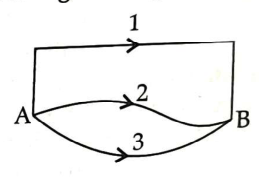
A gravitational field is present in a region and a mass is shifted from A to B through different paths as shown. If W₁, W₂ and W₃ represent the work done by the gravitational force along the respective paths, then: [Image of paths 1, 2, 3 from A to B]
- ✅W₁ = W₂ = W₃
- B)W₁ > W₂ > W₃
- C)W₁ > W₃ > W₂
- D)W₁ < W₂ < W₃
The concept behind this problem
The question asks for the work done along three different routes between the same points, directly testing the path‑independence property of a conservative force.
Step by step
- 1Gravitational force is conservative, so work done depends only on initial and final positions, not on the path taken.
- 2Since all three paths start at A and end at B, W₁ = W₂ = W₃.
Watch out
Students often try to compute W on each segment with W = F·s, forgetting that the net work is the same for all paths.
Common slip-ups that cost marks
- •Treating gravity as a constant vector along curved paths – it varies with direction and magnitude
- •Mixing up sign: work done by gravity is negative of the increase in potential energy
- •Assuming that ‘path‑independent’ means the work is zero; it is zero only for a closed loop
🌟 That's the whole idea — you've got this. Try the practice set below; every question you attempt makes it stick a little harder.
Practise it
These are real questions from past NEET papers that test this exact idea.
A gravitational field is present in a region and a mass is shifted from A to B through different paths as shown. If W₁, W₂ and W₃ represent the work done by the gravitational force along the respective paths, then: [Image of paths 1, 2, 3 from A to B]
More from Gravitation
Acceleration due to gravity and its variation
Acceleration due to gravity (g) is the acceleration experienced by a body due to Earth's gravity, and it varies with height, depth, and planetary properties.
Kepler's laws of planetary motion
Kepler's laws describe the motion of planets and satellites: orbits are ellipses (first law), equal areas are swept in equal times (second law), and the square of the period is proportional to the cube of the semi-major axis (third law).
Gravitational potential energy and work
Gravitational potential energy is the energy an object possesses due to its position in a gravitational field, and work is required to move it against gravity.
Satellite motion and orbital parameters
Satellite motion involves understanding orbital velocity, time period, escape velocity, and the specific conditions for geostationary orbits.
Newton's law of universal gravitation
Newton's law of universal gravitation states that every two masses attract each other with a force directly proportional to the product of their masses and inversely proportional to the square of the distance between them.
Gravitational field and potential
The gravitational field describes the force per unit mass at a point in space due to one or more masses, while gravitational potential is the work done per unit mass to bring a mass from infinity to that point.