Ideal gas law and gas laws
The ideal gas law and related gas laws describe the relationships between pressure, volume, temperature, and number of moles for ideal gases.
Why this shows up in the exam
You need to apply these laws to solve problems involving gas mixtures, changes of state, and calculations of unknown quantities on NEET.
How NEET tests this
Learn the idea
The ideal gas law links pressure, volume, temperature and amount of gas; using PV = NkT lets you count individual molecules, while PV = nRT works with moles.
🧠 Memory hook: PV = NkT – think “P V equals Number times k times Temperature”, like a tiny R multiplied by each particle.
Get this one clearly and it pays off every single time it shows up in the paper. 🎯
Formulas & facts to keep ready
- PV = nRT (R = 8.314 J mol⁻¹ K⁻¹)
- PV = NkT (k = 1.38×10⁻²³ J K⁻¹)
- n = N/Na (Na = 6.022×10²³ mol⁻¹)
- Average kinetic energy per molecule = (3/2)kT
- At STP, T = 273 K, P = 1 atm = 101325 Pa, V = 22.4 L per mole
- 1 L = 0.001 m³
How to approach it
- 1Write down what is given and what is asked
- 2Convert all quantities to SI units (Pa, m³, K)
- 3Choose the form of the gas law that matches the unknown (use PV = NkT when N is required)
- 4Solve algebraically, then if needed use Na to switch between N and n
Worked example — watch it click
Temperature of an ideal gas is T K and average kinetic energy is E = 2.07 × 10⁻²³ T J mol⁻¹. Number of molecules in 1 L gas at STP will be :
- ✅2.68 x 10²²
- B)2.68 x 10²⁵
- C)2.68 x 10²⁸
- D)1.68 x 10²²
The concept behind this problem
The example asks for the number of molecules, so the PV = NkT form is required; the kinetic‑energy formula tells us the temperature‑dependence of kT.
Step by step
- 1Average KE per molecule = (3/2)kT.
- 2Given E = 2.07×10⁻²³ T J/mol should be per molecule.
- 3At STP: T = 273K, P = 1 atm, V = 1L.
- 4Using PV = NkT: N = PV/(kT) = (101325 Pa × 0.001 m³)/(1.38×10⁻²³ × 273) ≈ 2.68×10²² molecules.
Watch out
Treating the given kinetic‑energy expression as per‑mole and using R instead of k, which would give the wrong 10²5 magnitude.
Common slip-ups that cost marks
- •Confusing the gas constant R with Boltzmann constant k
- •Using Celsius instead of Kelvin for temperature
- •Ignoring unit conversion for pressure or volume
🌟 That's the whole idea — you've got this. Try the practice set below; every question you attempt makes it stick a little harder.
Practise it
These are real questions from past NEET papers that test this exact idea.
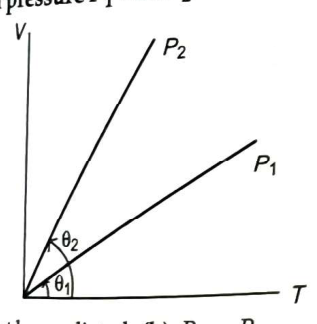
In the given (V-T) diagram, what is the relation between pressure P₁ and P₂?
Push further
More challenging15 harder questions built from the past papers above — a step up in difficulty, with distractors designed so you can't get there by elimination. Written and checked by our reviewers, not from a real paper.
At a certain temperature and pressure, 10 liters of an ideal gas has a mass of 20 g. If the molecular weight of the gas is 40 g/mol, what is the value of 'n' in the ideal gas equation PV = nRT for this sample?
More from Kinetic Theory of Gases
Degrees of freedom and thermal properties
Degrees of freedom determine the distribution of energy among molecules, affecting internal energy, specific heats, and the ratio of specific heats (γ).
Kinetic theory and molecular motion
The kinetic theory explains the behavior of gases in terms of the motion and collisions of their molecules, relating properties like pressure, temperature, and kinetic energy.
RMS speed and temperature dependence
The root mean square (rms) speed of gas molecules depends on temperature and molar mass, and is a key measure of molecular motion in gases.
Mean free path and collisions
Mean free path is the average distance a molecule travels between collisions, and depends on molecular size and number density.
Ideal-Gas Equation and Molecular Form
For a dilute ideal gas in thermal equilibrium, the state variables satisfy PV = nRT = Nk_B T, where intermolecular potential energy and molecular volume are neglected.
Gas Laws, Process Constraints, and State Graphs
For a fixed amount of ideal gas, P1V1/T1 = P2V2/T2; isothermal, isobaric, and isochoric laws follow by holding T, P, or V constant, respectively.