Thermodynamic Processes and P-V Diagrams
Study different thermodynamic processes (isothermal, isobaric, isochoric, adiabatic, polytropic, cyclic), their definitions, characteristics, and graphical representation on P-V diagrams.
Why this shows up in the exam
NEET questions frequently require you to identify, analyze, and compare processes using P-V diagrams and process definitions.
How NEET tests this
Practise it
These are real questions from past NEET papers that test this exact idea.
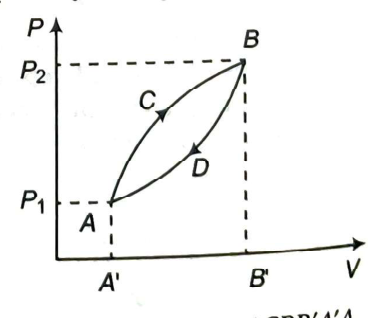
A thermodynamic system is taken from state A to B along ACB and is brought back to A along BDA as shown in the P-V diagram. The net work done during the complete cycle is given by the area:
Push further
More challenging8 harder questions built from the past papers above — a step up in difficulty, with distractors designed so you can't get there by elimination. Written and checked by our reviewers, not from a real paper.
An ideal gas is taken through a cyclic process involving an isothermal expansion, followed by an isochoric cooling, and finally an adiabatic compression back to its initial state. Which of the following statements is true regarding this cycle?
More from Thermodynamics
Laws of Thermodynamics
Understand the zeroth and first laws of thermodynamics, including their statements, implications, and applications to physical systems.
Internal Energy, Heat, and Work
Explore the concepts of internal energy, heat, and work, including their definitions, relationships, and how they change during various thermodynamic processes.
Ideal Gas Law and Equation
Learn the ideal gas equation, its relation to physical quantities like pressure, volume, temperature, and density, and its use in describing the behavior of ideal gases.
Gibbs Free Energy and Spontaneity
Learn how Gibbs free energy determines spontaneity, how to calculate it, and its dependence on temperature, pressure, and other thermodynamic parameters.
Entropy and Its Changes
Understand entropy as a measure of disorder, how it changes in physical and chemical processes, and its calculation in various scenarios including phase transitions and isothermal processes.
Enthalpy Changes and Bond Energies
Learn to calculate enthalpy changes for reactions using bond enthalpies, enthalpy of formation, and Hess's law.